Bondsavvy recommended four new corporate bonds March 5 to Premier Service subscribers. Due to higher bond yields since then, three of the four bonds are now available at prices between 1.0 and 1.6 points lower than the pick date price. As of 11:30am EDT on March 13, one of the bonds had a YTM over 9%. The three other bonds had YTMs ranging from the low- to mid-5s.
These four new recommended corporate bonds are in addition to the 29 other bonds we currently rate 'buy.' Subscribe to Bondsavvy Premier to gain access to all of our recommended corporate bonds.
This fixed income blog post previews the 27 recommended corporate bonds Bondsavvy has presented since November 2024. Key takeaways include:
- As of approximately 11:30am EDT on March 13, the average YTM of our 27 most recent recommended corporate bonds to buy was 5.85%, 5.4 times higher than the approximate 1.08% S&P 500 dividend yield.
- Through February 27, 2026, 22 of the 23 bonds we recommended between November 2024 and November 2025 outperformed the iShares LQD and HYG corporate bond ETFs. Bondsavvy outperformed an average of 2.93 points per bond recommendation.
- Corporate bond returns are not capped at a bond's yield to maturity. For our 89 exited recommendations, approximately one-third of the total return came from capital gain, with the remainder from interest income.
- The recommended corporate bonds to buy include a variety of maturity dates, including 16 bonds maturing in 10 years or fewer; 6 bonds maturing between 11 and 19 years; and 5 bonds maturing in 20 or more years.
Please note that we update our recommended corporate bonds each quarter, including our next Premier Service update on March 26, 2026. Since 2017, Bondsavvy has recommended approximately 150 corporate bonds. In addition to the previously mentioned 27 best individual corporate bonds to buy now, we have six other bonds rated 'buy' and 32 rated 'hold.'
Our Recommended Bonds to Buy 2026 Preview
Before Bondsavvy, investors seeking the best individual corporate bonds to buy had to sift through over 10,000 corporate bonds available when buying bonds online. Since 2017, Bondsavvy has made bond investing easy and more profitable by presenting approximately 20 new recommended corporate bonds each year.
While our 89 previously exited recommended corporate bonds skewed toward high yield corporate bonds, 20 of our most recent 27 recommended bonds to buy had investment grade bond ratings.
Bondsavvy makes new corporate bond recommendations each quarter during The Bondcast, a webinar exclusive to Bondsavvy subscribers. The 65 bonds currently on the Bondsavvy Premier recommended corporate bonds list (including 33 rated buy and 32 rated hold) offer a wide range of maturity dates and are from issuers across over 15 different industry groups. We will update all of our best individual corporate bonds to buy now on March 26, 2026 during the quarterly Super Bondcast investment webinar.
Why Own Our Best Individual Corporate Bonds to Buy
Owning individual corporate bonds enables investors to lock in high income for a specific time period and to
have the opportunity for capital appreciation. Individual corporate bonds also, at maturity, provide for a return of
the $1,000
face value for each bond you own. That said, we seek to achieve corporate bond returns that exceed a bond's pick date yield to maturity by using our active bond investing strategy.
Since corporate bonds are priced as a percentage of their face value, investors can evaluate a bond's price, YTM, and
credit spread and compare these metrics to the
bond issuer's financials. This financial analysis is the heart of the Bondsavvy investment service and enables us to identify bonds that can achieve
strong total returns over the long term. This analysis is not possible when investing in bond funds and ETFs, as we
discuss below.
A compelling alternative to money markets, CDs, and bond funds
In the December 2025 Fed dot plot, the US Federal Reserve
projected one-half point of additional interest rate cuts through 2027. Should this happen, popular money market funds such as Vanguard VMFXX
would see their yields fall to approximately 3.10%. In addition, since Vanguard VMFXX targets a net
asset value per share of $1.00, VMFXX cannot have capital appreciation. Some CD rates may currently seem attractive;
however, CDs often pay their income at the end of their term (compared to corporate bonds, which pay interest
semi-annually), can come with onerous call provisions, and lack capital appreciation opportunities.
Mega bond funds such as Vanguard VBTLX are not fixed income investments. They do not
pay a fixed coupon and do not return an investor's principal at maturity, as they do not have a maturity
date. Bond funds such as VBTLX own thousands of bonds, which drives muted (and often low) returns and makes
investors unable to build a portfolio that fits their investment objectives. Further, since bond funds and ETFs do
not trade relative to a par value and lack underlying financial metrics, investors cannot assess whether a
bond fund investment represents a compelling value.
Owning individual bonds vs. bond funds is the lowest-cost way to invest in bonds, as investors do not pay recurring fees based on a percentage of what they invest. In addition, bond funds incur significant trading costs. Bond funds do not disclose the amount of these costs and exclude them from the "expense ratio" fund managers, such as Vanguard, trumpet. By taking actions to limit our market impact, we have enabled our subscribers to purchase bonds at competitive prices and to maximize their corporate bond returns.
Higher US Treasury Yields Have Improved Bond-Buying Opportunities
As we discuss in our corporate bond credit spreads blog post, US Treasury yields and credit spreads are the two components of US corporate bond yields. Figure 1 shows four recent US Treasury yield curves, which enable investors to evaluate the value available in the US bond market. Higher bond yields typically mean more bang for your investing buck.
As shown in Figure 1, the recent trough of US Treasury yields was January 4, 2022, which came before the US Federal Reserve began increasing interest rates in March 2022. The recent peak US Treasury yield curve occurred on October 19, 2023. When US Treasury yields are relatively high, there is generally greater value available in bonds, as investors are receiving a higher level of income and bond prices generally have a greater chance of increasing.
While the US Treasury yield curve on March 13, 2026 was not as high as the October 19, 2023 yield curve, the 30-year US Treasury yield was within 20 basis points of the 5.11% high reached October 19, 2023. Between March 5 and March 13, 2026, 2-, 5-, 10-, 20-, and 30-year US Treasury yields have all increased between 16 to 20 basis points.
Figure 1: Recent US Treasury Yield Curves
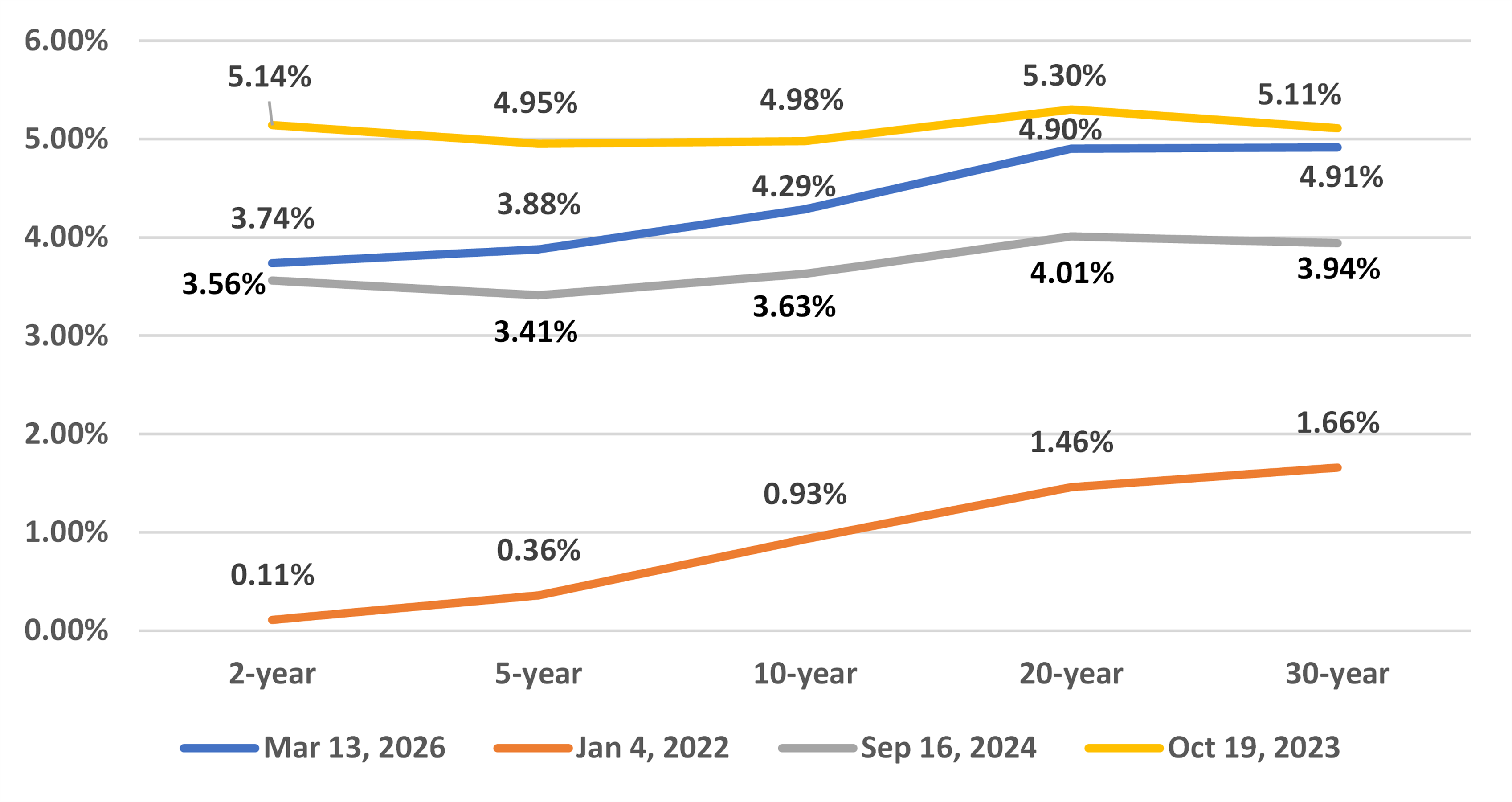
Source: Tradeweb data as shown on CNBC.com and graphed by Bondsavvy. March 13, 2026 yields as of 11:30am EDT.
Of course, US Treasury yields are only one part of the corporate bond yield puzzle. Changes in corporate bond credit spreads can either magnify or mitigate a corporate bond yield's change. For the four best individual corporate bonds to buy now from March 5, 2026, changes in credit spreads ranged from a 21-basis-point decline for one bond to 6-, 8-, and 13-basis-point increases for the three other recommended corporate bonds.
Why Own Corporate Bonds Now
We strongly advocate investors build bond portfolios over time; however, as of this update, there are several factors making now a compelling time to invest in individual corporate bonds:
- Investors seeking the best individual corporate bonds to buy now can lock in high yields for the long term. In addition, since Bondsavvy's recommendations are highly selective, we can identify bonds that can increase in price and achieve total returns higher than a bond's purchase date yield to maturity.
- The 30-day SEC yield for iShares IVV was 1.05% as of February 28, 2026, about one-sixth the average YTM of our 27 individual corporate bonds to buy now. Income investors can generate higher income with greater principal protection by owning individual corporate bonds vs. dividend stocks.
- Money market 7-day yields, such as those for Vanguard VMFXX, have fallen about 1.8 points since September 2024, to 3.58% as of March 12, 2026. They could fall further toward 3% should the US Federal Reserve cut rates further per the December 2025 Fed dot plot.
- The S&P 500 has been trading near a 29x price-to-earnings (P/E) ratio compared to approximately 19x ten years ago, according to Gurufocus.com. Historically, investing in stocks at high multiples has been negatively correlated with investor returns.
- Funds mimicking the S&P 500, such as the $708 billion iShares IVV ETF, are not as diversified as the name "S&P 500" implies. As of March 12, 2026, the top-10 holdings of iShares IVV accounted for 37.5% of the fund's market value. The top-25 holdings accounted for 50.4% of the fund's value.
- Income distributions for bond funds and ETFs vary monthly and do not enable investors to lock in long-term income, as can be done with individual corporate bonds.
- Since bond funds and ETFs do not trade relative to par value and lack underlying financial metrics, investors cannot assess whether bond funds or ETFs are trading at compelling values.
Get Started
Watch Free Sample